
How to Plan a D&D / TTRPG Game Session
Preparing for your Tabletop RPG session can be quite daunting even for game masters that have run weekly games. Whether you have been learning a new system and are just trying to find your feet, or you want to improve your planning for future sessions coming up, giving yourself a task list to follow of some simple steps to remember can always help when you’re stuck for ideas.
1. Set a Date and Time with your Players
I’ve been in countless groups that have ended with sessions needing to be reorganised or cancelled simply because the whole group was not on the same page with regards to when their games were on. Even in groups where you would think it is safe to assume that because the last couple of times you’ve ended up doing it on the last Friday of the month, you will only be able to guarantee the attendance of your entire group if the date and time is agreed on. It helps to clear up everything, and means people either wont schedule something else for that time, or be able to let you know if they have other plans ahead of time. Leave this information somewhere that people can be reminded about it, like making an event people can add to their calender apps or using Roll20’s game schedule system.
2. Make a List of Plot Points
Now that you know when your game is and how long you should be playing for, try jotting down a list of ideas so that you can pick the kind of game you want to run. This is the opportunity for you to just dump a load of potential ideas or story routes down on paper and make a choice from them. You can always revisit other ideas for other sessions.
3. Decide on your favourite ones and how the party might get there.
Pick one, or a couple if you think your party can handle it in the time and take a look at where your adventuring party is starting or where you left them. Do the party need to be brought together? What kind of incidents could happen to cause them to meet one another, or do they already know one another? If the party need to travel, how will you get them there? What can you make happen to drive the players to want to follow that plot? Think of inciting incidents that could cause someone to want to participate in the story. If you want the party to storm a jail and rescue a wrongly convicted man, do the party need to be persuaded by a worried lover? Bribed by a crime lord? Or do they just need to witness the injustice of his arrest? Maybe you need to plan a light hearted scene at the tavern the night before his arrest where the party befriend the NPC and become invested in his life before throwing him to the justice system.
4. List the NPCs involved an a little bit about them
Once you have an idea of your story for the session you will know what kind of characters you will need to tell it. You might need to create a Villain, a Victim, a Quest Giver or just simple passers by who can show your players how the actions happening around them effect the world and it’s people. Make a basic list of the people you think your players would come across and a few basic details like their Name, what they might look like, a quirk that might help your players differentiate them from other characters when you perform them, etc. If these NPCs might be involved in Combat you can create their character sheet in one of the later stages, but always be prepared to wing a couple of basic stats in case a player needs them to make a contested ability check or saving throw.
5. Decide if you need any handouts, maps, images etc.
Whether you are playing face to face or digitally, it’s nice to change things up for your players. Remember that not everyone is a keen listener, and people can learn visually or practically too. Providing tactile things like folded printouts of books or letters that the party might find along their journey to help their quest are great things to help make the session a little more immersive. You can collect images of scenes or people that the players come across to display on screens for them. Not only will this help you to come up with descriptions on the fly of what is in your minds eye, but if the players are able to see them whilst you talk it will help them to form a more solid memory of the person or place. If you feel that you don’t need handouts this session though, you can move on to the next step.
6. Prepare any combat encounters
If you plan to run combat this session, it is absolutely vital you make sure you have all the information you need gathered. Make sure you have the map you plan to run the combat on, and any tokens you need for both players and NPCS/Monsters. You will need to make sure you have at least read through the monster’s stats and have a basic understanding of what it’s capable of. Having an idea of what your players are capable of will also help you to plan what would be too much or too little of a challenge for them too. Don’t be afraid to ask your spellcasters for an updated list of their prepared spells.
If you don’t plan on running combat this session, take a look at the general idea of the sequence of events that might happen and check to see if there are any areas that a player might push their luck or resort to violence if they feel confronted. It’s always a good idea to have a general idea of what you would need on hand if they should initiate combat. It doesn’t have to be perfectly planned, but being somewhat prepared will make it a little less chaotic when it inevitably does happen.
7. Remind your players about the upcoming game.
At this point it has at least been 24 hours since you last spoke to your players about it. If the game is coming up in the next couple of days I strongly recommend just dropping them a quick message to confirm that everyone is still okay with the time, place and date. Sometimes things happen unexpectedly, and its natural that people may need to cancel last minute. If you continue opening up dialogue for your players to let you know if there’s issues with what has been organised, they should be comfortable with letting you know if they need to skip or drop out for a session or two.
8. Set up your gaming space
Whether you are playing in person or online, you’re about to sit in one space to play for a fair few hours, take the time to make it comfortable, make sure the space is clear for the things you need, and make sure that you have everything at hand. If you’re playing in person you can think about dressing up the space a little, or what the lighting might be like. Check on your video and audio equipment if you’re playing online, or make sure any technical issues are ironed out so you’re not stuck in the lag zone.
9. Acquire Snacks and Water
Make sure you’re hydrated. As you’re the game master you’re going to be talking a lot, and you’re also going to be using a lot of your energy. Whilst your players might be able to take a couple of minutes to let other players have their moment, you are going to be active the entire session. Grab a few snacks that can help keep your energy up during the session, and keep water (or your drink of choice) nearby.
Side Note: Be considerate when consuming alcohol. As you’re the Game Master of the group, there is a certain responsibility that you take with running the game. Always be aware of your limit, and when alcohol might be affecting your ability to run the game, the last thing you want is a fall out or to make a player uncomfortable whilst playing drunk. If you’re in a group of familiar friends where everyone is happy and consenting to a drinking party and game session feel free to have fun.
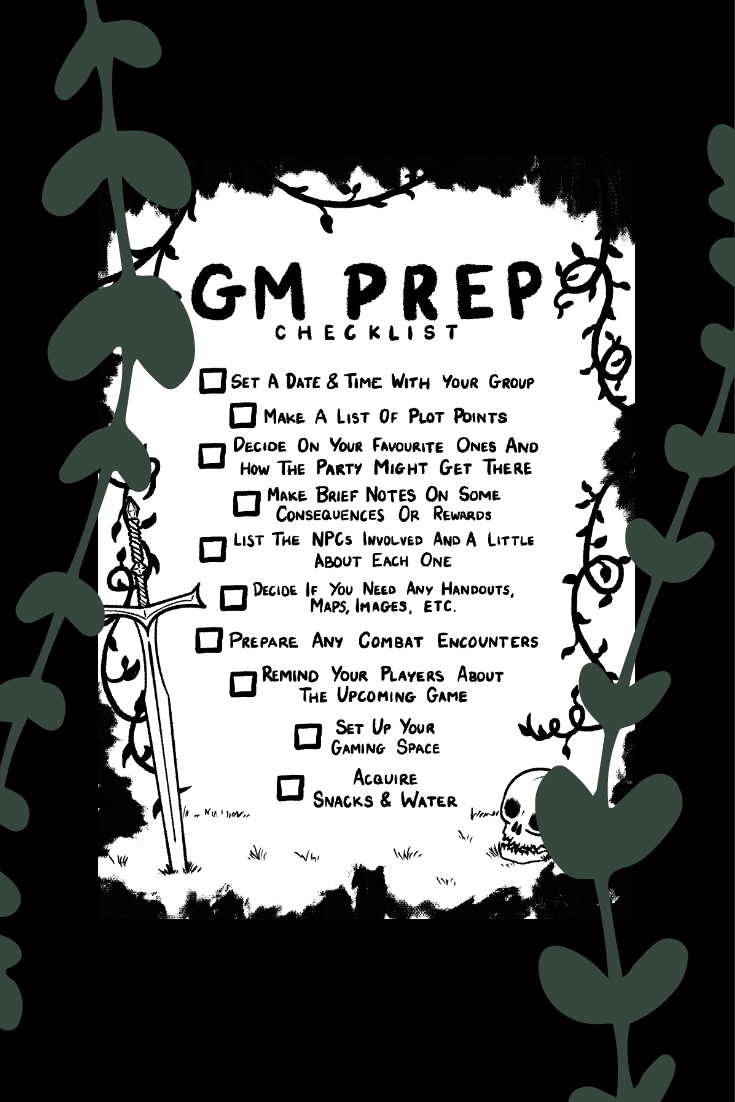
![The GM Prep Checklist [Printable JPG]](https://images.squarespace-cdn.com/content/v1/5f6a16c00e30fc4f10e7bc7d/1634318255294-9V1E1WQ66B5EKHFXGBPH/Adobe_Post_20211015_1808320.0021248540720693043.png)
Prepping for any Tabletop RPG can be a little daunting when you don’t know what you’re supposed to do next. This checklist helps to break down each of the steps you need to take to play a good game with your friends. I recommend printing a few of these out on one a4 sheet of paper and using them as a checklist you can put in your notebook.
For more tips on what to do for each of the points, check our blog post!
This free download comes with a printable JPG file
LANGUAGES: This file is currently written in UK English
—
By purchasing this item you are agreeing to an instant download of the product.
Hopefully you’ve found this useful to help you plan for your next TTRPG session, we’ve got plenty of other goodies for people who want to organise their games better so why not check out the rest of the blog and shop!
See you all next week!